

Where to find memory
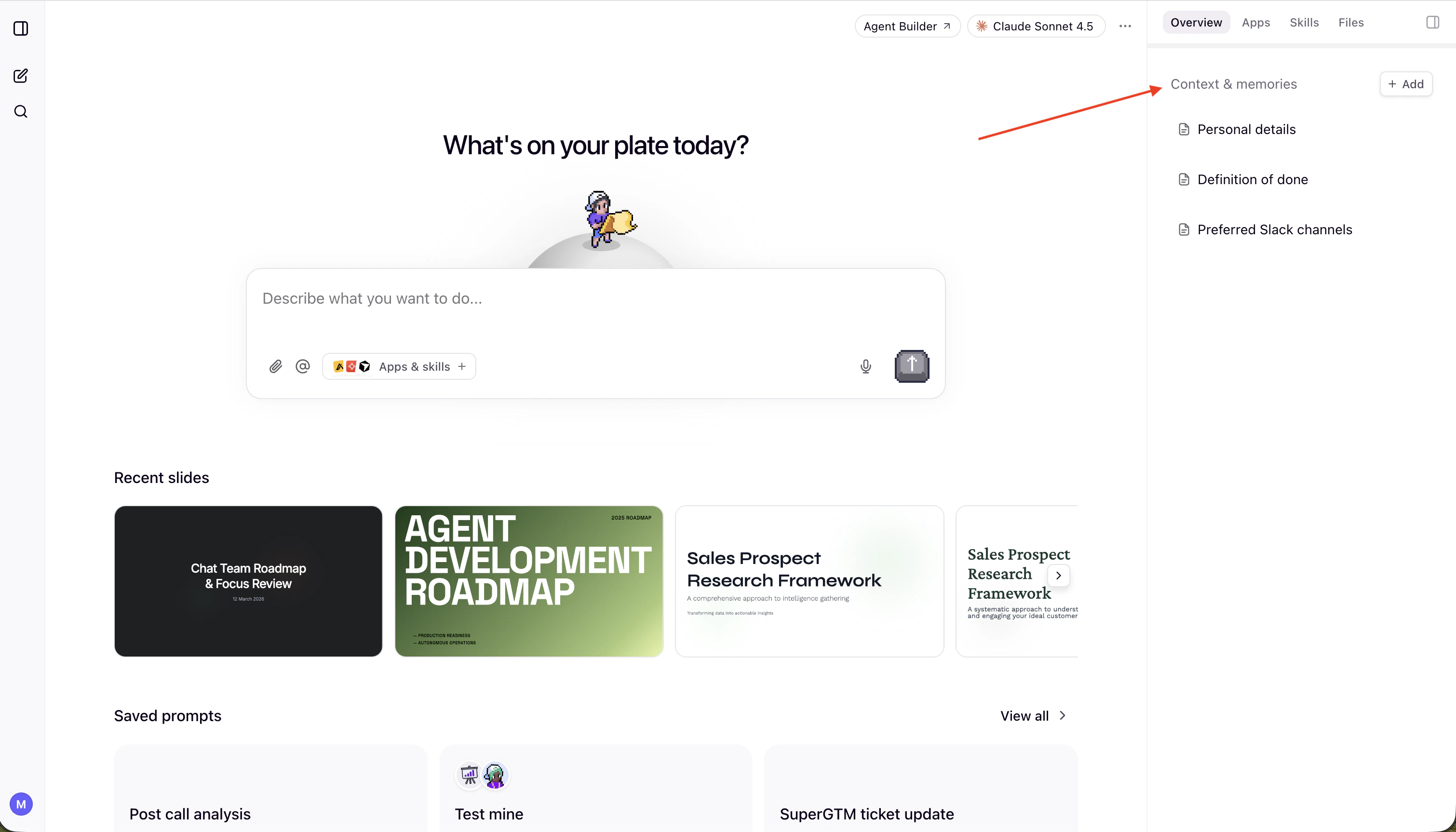
Memory is scoped per user. Your memory is not shared with other users in your project.
How it works
The agent maintains a memory entry for each thing it learns about you. At the start of each conversation, the agent reads a memory index and opens the individual entries relevant to your request. Those are loaded into the agent’s context alongside your message. The agent doesn’t load everything every time — it loads what’s relevant. The more clearly your memories are described, the better the selection works.Memory types
User memory
User memory
Information about you — your role, goals, expertise, and preferences. The agent uses this to tailor its work to who you are.Examples:
- “VP of Sales at Relevance AI, manages a team of 8 AEs focused on enterprise accounts”
- “Prefers data-driven insights and concise communication”
- “Has deep HubSpot experience but is new to using Slack integrations”
Feedback memory
Feedback memory
Corrections and guidance you’ve given the agent. These are the most impactful memories — they prevent the agent from repeating mistakes.Examples:
- “Keep email drafts professional but warm — no corporate jargon. Start with the contact’s first name, not ‘Dear [Name]’”
- “Don’t include pricing in the first outreach email”
- “Always present data as bullet points, not paragraphs”
Project memory
Project memory
Context about ongoing work, goals, and timelines that the agent wouldn’t otherwise know.Examples:
- “Enterprise team has a $2.4M pipeline target for Q3, closing September 30. Board review is October 5”
- “The Q2 campaign is focused on enterprise expansion — prioritize enterprise accounts in any outreach”
- “Product launch is scheduled for June 15 — all deliverables need to be finalized by June 10”
Reference memory
Reference memory
Pointers to where information lives, so the agent knows where to look.Examples:
- “Deal stage definitions are in the HubSpot wiki under ‘Sales Process > Deal Stages’”
- “The competitive analysis is saved in project files under /research/competitors.md”
- “Customer feedback is tracked in the Notion database called ‘Product Feedback‘“
Building up memory over time
You don’t need to set up memory all at once. The agent builds it naturally as you work together.- Tell it to remember
- Correct it
- Tell it to forget
Ask the agent to save something to memory at any time:
“Remember that I prefer bullet points over paragraphs”
“Remember that the Q3 target is $2.4M”The agent will confirm what it stored and which memory type it used.
How skills and memory work together
Skills and memory complement each other:- Skills define the process. A skill tells the agent how to do something — the steps, the data sources, the output format.
- Memory personalizes the execution. Memory tells the agent your way of doing it — your tone, your preferences, your priorities.